
Fraunhofer: Easy Mobile Food Fraud Detection
March 2026. Counterfeit or low-quality products – such as olive oil made from dyed rape-seed oil – are often difficult or impossible to identify at a glance. A mobile gas chromatography sensor system is now being developed to help detect falsely labeled products directly on site. Three Fraunhofer institutes are working together to create an affordable, easy-to-use device that enables even non-experts to perform rapid, on-the-spot assessments.
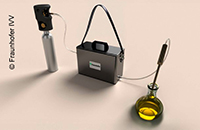
Food fraud has been on the rise for years. High demand, intense price competition and complex supply chains create ideal conditions for mislabeling. If harmful ingredients are used, this type of fraud can pose serious health risks. Until now, detecting counterfeit foods has required costly and time-consuming laboratory analyses. In addition, lab-based analysis systems require trained specialists to operate the equipment and interpret the data. Fraunhofer researchers are working to address these issues. Research teams at the Fraunhofer Institutes for Photonic Microsystems IPMS, for Molecular Biology and Applied Ecology IME and for Process Engineering and Packaging IVV are working to address these issues. Their goal is to develop a mobile gas chromatography sensor system for rapid on-site detection of volatile organic compounds (VOCs). VOCs are chemical compounds that reveal information about a material’s composition or possible health hazards and can signal changes in product characteristics. The detection of VOCs plays an important role in many fields, including food quality and safety, healthcare, civil security, agriculture and the chemical industry. In the case of olive oil (see photo), the goal is to determine parameters, such as country of origin, age and purity level.
Current tests using a conventional three-meter GC column demonstrate reliable separation of VOCs and enable effective sample analysis. GC columns in conventional, high-end laboratory gas chromatographs are often over 30 meters long and deliver higher separation efficiency, but this level of efficiency is not required for quality assessment of most foods. Among other challenges, the Fraunhofer researchers are working to design miniaturized GC columns capable of providing sufficient separation of VOCs specific to different foods.
The researchers presented some results at the Analytica 2025 trade fair in Munich.
Source: Fraunhofer
Disclaimer: You agree that B2Bioworld is not responsible and will not be held liable for any third party content on its sites or any third-party content, products or services available on other web sites accessed through links from B2Bioworld sites. Links to third-party sites are for your convenience only, and their inclusion on B2Bioworld\'s sites does not imply any endorsement, guarantee, warranty or representation by B2Bioworld.
Other articles recommended
B2Bioworld offers you background information
MERCOSUR Bets for Bids
A critical look inside Mercosur, the EU strategy, accompanied by an interview with Fernando Mattos Costa, Uruguay's former Minister of Agriculture and co-negotiator of the EU-Mercosur agreement.
Innovation – Try Again, Fail Again, Fail Better
Ulrich Betz, Vice President Department Head Innovation & Entrepreneurship Incubator; Merck Biopharma
Straight talking to MECA countries
Governance, anti-corruption, agriculture, digitization, citizen engagement, freedom of press, AMIS and Georgia
Lab Shows: Where Is the Core Community?
Jochen Koeckler, CEO of Deutsche Messe AG substitutes a profitable biotech show and re-sizes a trade fair for the laboratory world
Industrial Bioscience: Solutions Marketing Never Dreamt of…
David Nicholson, CSO Bayer CropScience on Hidden Potentials, Re-valuation of IP Assets, and Substantial Changes in R&D